Sikh Wedding Guide · 7 minute read
What is Anand Karaj? The Complete Guide to the Sikh Wedding Ceremony
The four Laavan. The palla. The thirty minutes that change everything. Here is what every guest, photographer, and couple needs to know about the heart of every Sikh wedding.
Published by the YourLavaan Team
In this guide
→ What is the Anand Karaj meaning?
→ What happens during the ceremony?
→ How long does an Anand Karaj take?
→ What to wear to a Sikh wedding
→ Can non-Sikhs attend?
→ Sikh wedding traditions to know
→ For photographers and videographers
→ Preparing for your own Anand Karaj
→ FAQs about Anand Karaj
You have been invited to a Sikh wedding. Or maybe you are planning one. Or maybe you are a Sikh who has sat through a dozen Anand Karaj ceremonies and realised you have spent most of them too moved to fully follow what was happening.
Either way, this one is for you.
The Anand Karaj is the heart of every Sikh wedding. Not the reception. Not the outfits. Not the dhol outside the Gurdwara (although all of those are genuinely wonderful). The ceremony itself is the marriage. And it is unlike anything else.
Here is everything you need to know.
What is Anand Karaj?
Anand Karaj is the Sikh wedding ceremony. The name translates from Punjabi as “blissful union,” and in Sikhism, that word blissful carries real weight.
This is not just two people committing to each other. It is two souls beginning a shared journey towards Waheguru.
The Anand Karaj was introduced by Guru Amar Das Ji, the third Sikh Guru, and formalised by Guru Ram Das Ji, the same Guru who composed the four Laavan, the sacred hymns that form the central moment of every Sikh wedding.
The ceremony is conducted in the presence of Sri Guru Granth Sahib Ji, the eternal living Guru of the Sikhs. Sikhs regard the Guru Granth Sahib Ji as the king of kings. Not a book, but a living presence. Everything in the Darbar Sahib is oriented towards that. Whether the wedding is in Southall, Toronto, New Delhi, or Sydney, the Anand Karaj centres on the Guru Granth Sahib and the four Laavan. Always.
What is the Anand Karaj meaning?
The four Laavan are four verses of Gurbani, the sacred scripture of Sikhism, composed by Guru Ram Das Ji. Each verse describes a different stage of the couple’s spiritual journey together.
The first Laav is about beginning. Starting the journey properly, with Waheguru’s guidance and a commitment to living righteously.
The second Laav is about drawing closer. The couple moving towards the divine through love and devotion.
The third Laav describes longing becoming belonging. The soul finding peace.
The fourth Laav is union. The soul and Waheguru becoming one through complete devotion.
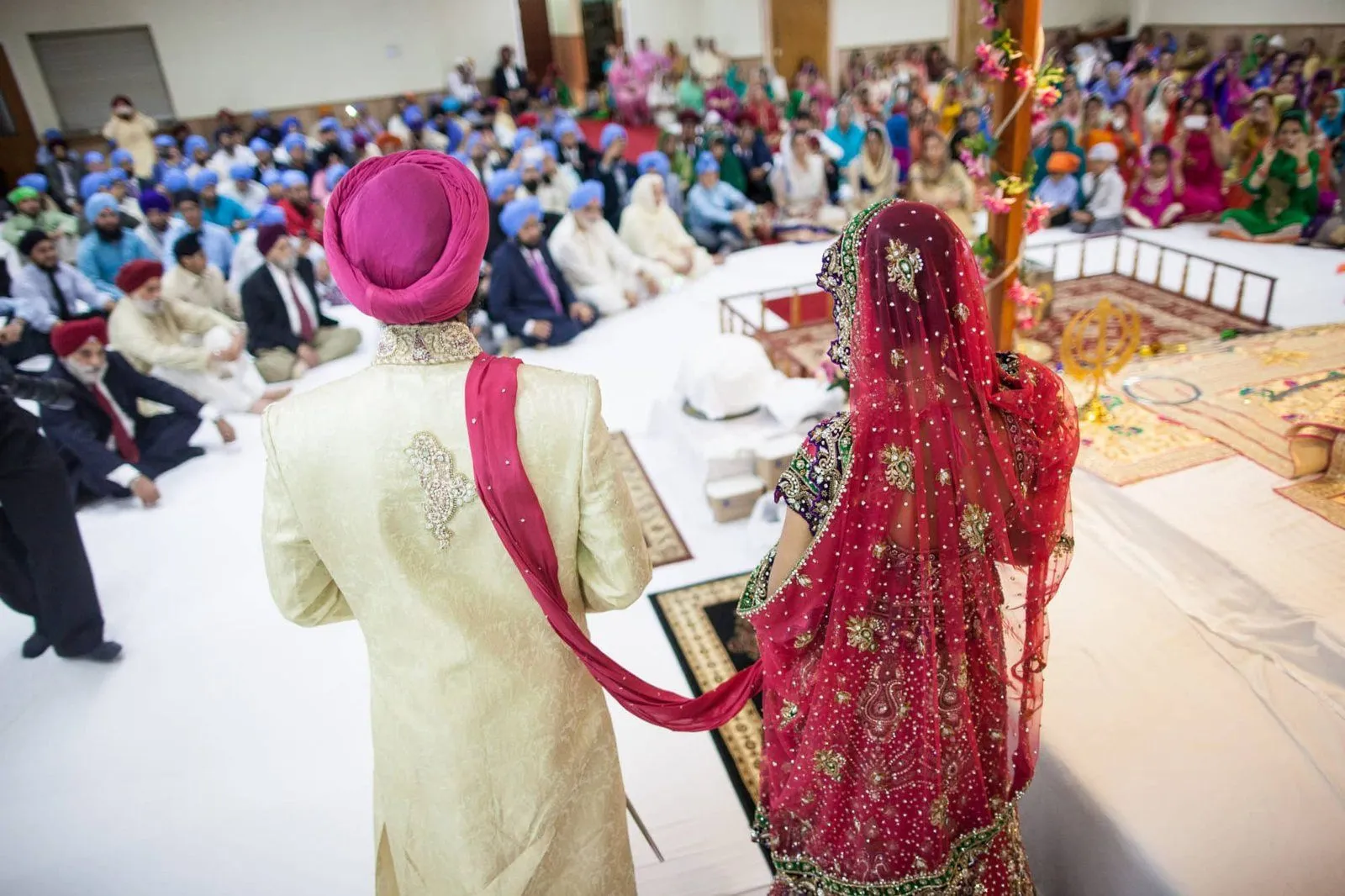
Each verse is read by the Granthi and then sung by the ragis as the couple walks around the Guru Granth Sahib. Four verses. Four rounds. By the end of the fourth, they are married.
“Two people, four rounds, one lifetime.”
The full text and official guidance on the ceremony is set out in the Sikh Rehat Maryada, published by the Shiromani Gurdwara Parbandhak Committee (SGPC), the highest Sikh authority on religious practice.
What happens during the Anand Karaj ceremony?
Here is the Anand Karaj ceremony in order.
1Arrival and Ardas. The ceremony begins with Ardas, a collective prayer offered by the whole congregation. Everyone present participates. This is a moment to be still and present.
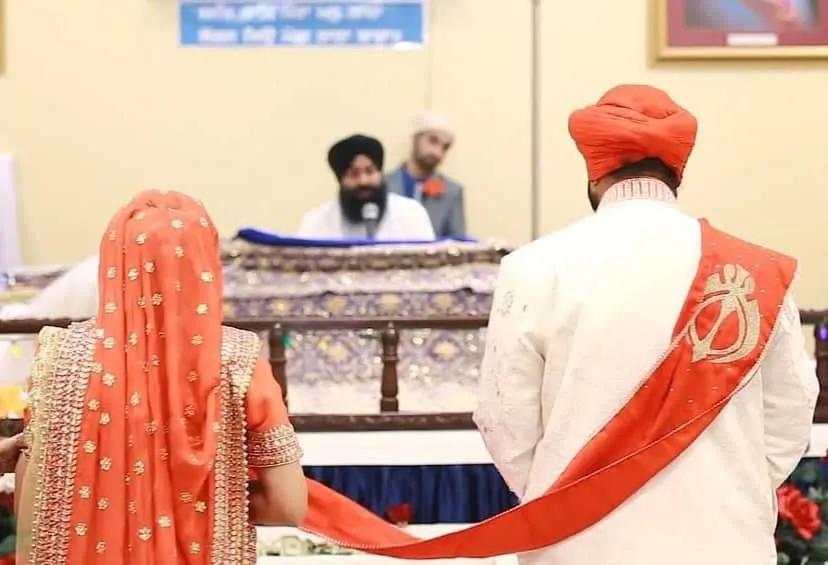
2The Palla ceremony. The bride holds one end of a palla (a long scarf, usually pink or cream) and her father holds the other. He then places it into the groom’s hands, symbolising the family entrusting their daughter to her new husband. It tends to hit people harder than they expect.
3The four Laavan. The Granthi reads each of the four verses of Gurbani. The ragis sing each one. The couple walks around the Guru Granth Sahib together, the groom in front, the bride following, connected by the palla. Four times. One round for each Laav.
4Anand Sahib. After the fourth Laav, the shabad Anand Sahib is recited. A hymn of bliss and joy.
5Closing Ardas. A final prayer is offered by the whole congregation, formally closing the ceremony.
6Karah Prasad. A warm, sweet offering made from equal parts flour, ghee, and sugar is distributed to the entire congregation. Receive it by cupping both hands out together. Everyone gets it. That is the point.
From start to finish, what happens in the Anand Karaj ceremony is this: two people walk into a Gurdwara separate and walk out married. Everything else is context.
For guidance on where the ceremony can and cannot take place, read our Destination Anand Karaj guide, which covers the important spiritual considerations around venue.
How long does an Anand Karaj take?
The Anand Karaj ceremony itself takes between 30 and 45 minutes. The four Laavan happen more quickly than most people expect. And yet it never feels short.
Include the arrival, the Ardas, the Palla, and the Karah Prasad distribution, and most ceremonies last between one and two hours in total.
The full Sikh wedding day is a different calculation entirely. The milni in the morning, the ceremony itself, the langar, and the evening reception can take the whole day. Come prepared, pace yourself, and eat something before you go if you need to.
What to wear to a Sikh wedding
Your head must be covered when you enter the Darbar Sahib. This applies to everyone, regardless of faith, gender, or background. Women typically cover their heads with a dupatta, shawl, or scarf (known as a Chuuni). Men use a patka, turban, or handkerchief. The Gurdwara will usually have head coverings available near the entrance if you do not have one.
Your shoes come off before you go in.
What to wear: Bright colours are actively encouraged. Sikh weddings are joyful occasions and the Gurdwara on a wedding day is one of the most colourful places you will ever stand in.
- Skirts (please wear trousers or full-length dresses)
- Shorts, tank tops, or mid-riff showing outfits
- Offensive prints
- Caps or hats (your head must be covered with a traditional head covering, not a cap)
- All-white or all-black outfits, which are associated with mourning in Punjabi culture
Modest, comfortable clothing is appreciated since you will be sitting on the floor for the duration of the ceremony.
Can non-Sikhs attend an Anand Karaj?
Yes. Fully and warmly.
Non-Sikh guests are welcomed at an Anand Karaj exactly as any other member of the congregation. The requirements are the same for everyone: head covered, shoes removed, sit respectfully.
A few things to know as a non-Sikh guest:
Sit comfortably in the cross-legged position and be mindful not to point your feet in the direction of the Guru Granth Sahib Ji, which is considered disrespectful in Sikh practice.
Face forward at all times. The Guru Granth Sahib Ji is the living Guru. Turning your back towards it is something to be mindful of.
Avoid talking during the ceremony. You are essentially sitting in the court of the Sikh Guru. The atmosphere deserves your respect and your full attention.
You do not need to understand Punjabi or know Gurbani to feel what is happening in the room. Many non-Sikh guests describe the Anand Karaj as the most moving ceremony they have ever attended.
Sikh wedding traditions worth knowing
A few things that often catch first-time guests by surprise.
Everyone sits on the floor. There are no chairs in the Darbar Sahib. Men and women traditionally sit on separate sides of the hall.
Leave quietly. When you leave the Darbar Sahib, do so in a quiet and considerate manner. Take all your personal belongings.
Accept the Karah Prasad. Cup both hands out together and receive it gratefully. Everyone in the room receives the same thing, regardless of background, faith, or social standing. That equality is the entire point.
Stay for langar if you can. After the Anand Karaj, the Gurdwara serves langar, a free communal meal open to absolutely everyone. One of the oldest and most quietly radical Sikh traditions. Do not miss it.
The Milni. Before the ceremony, the two families come together in a formal meeting. The best practice, in line with Sikh Maryada, is to keep the Milni as short as possible and limit it to immediate family members.
The Anand Karaj is legally recognised in the UK under the Marriage Act 1949, provided the ceremony takes place in a registered Gurdwara.
For photographers and videographers
If you are filming or photographing an Anand Karaj, YourLavaan produces printed guidance cards that are distributed at Sikh weddings specifically for camera operators. Here is what they say.
The Darbar Sahib is the court of the living Guru. Everything you capture should be done with that understanding.
No cigarettes on Gurdwara premises. Tobacco is prohibited for Sikhs. Please respect their values and do not bring it into the Gurdwara.
Do not lean against or touch the Palki Sahib (the throne of the Guru Granth Sahib Ji). The space around it requires the same respect as the king of kings.
Avoid walking around during Ardas (the standing prayer). Prepare your positions before it begins and remain still.
Avoid talking during the ceremony. Limit all disturbances and communicate in silence if you need to at all.
Never have your back to the Guru Granth Sahib Ji. Be conscious of your positioning throughout.
If you are a Sikh wedding business looking to connect with couples planning their Anand Karaj, YourLavaan has a directory of verified Sikh wedding suppliers including photographers and videographers.
Preparing for your own Anand Karaj
If you are the couple, here is what YourLavaan recommends in its guidance to help you enter the ceremony with the right mindset.
Listen to the Laavan di Bani before your wedding day. Hearing them beforehand, and reading the translations, gives you the space to reflect on what you are committing to, both individually and as a couple.
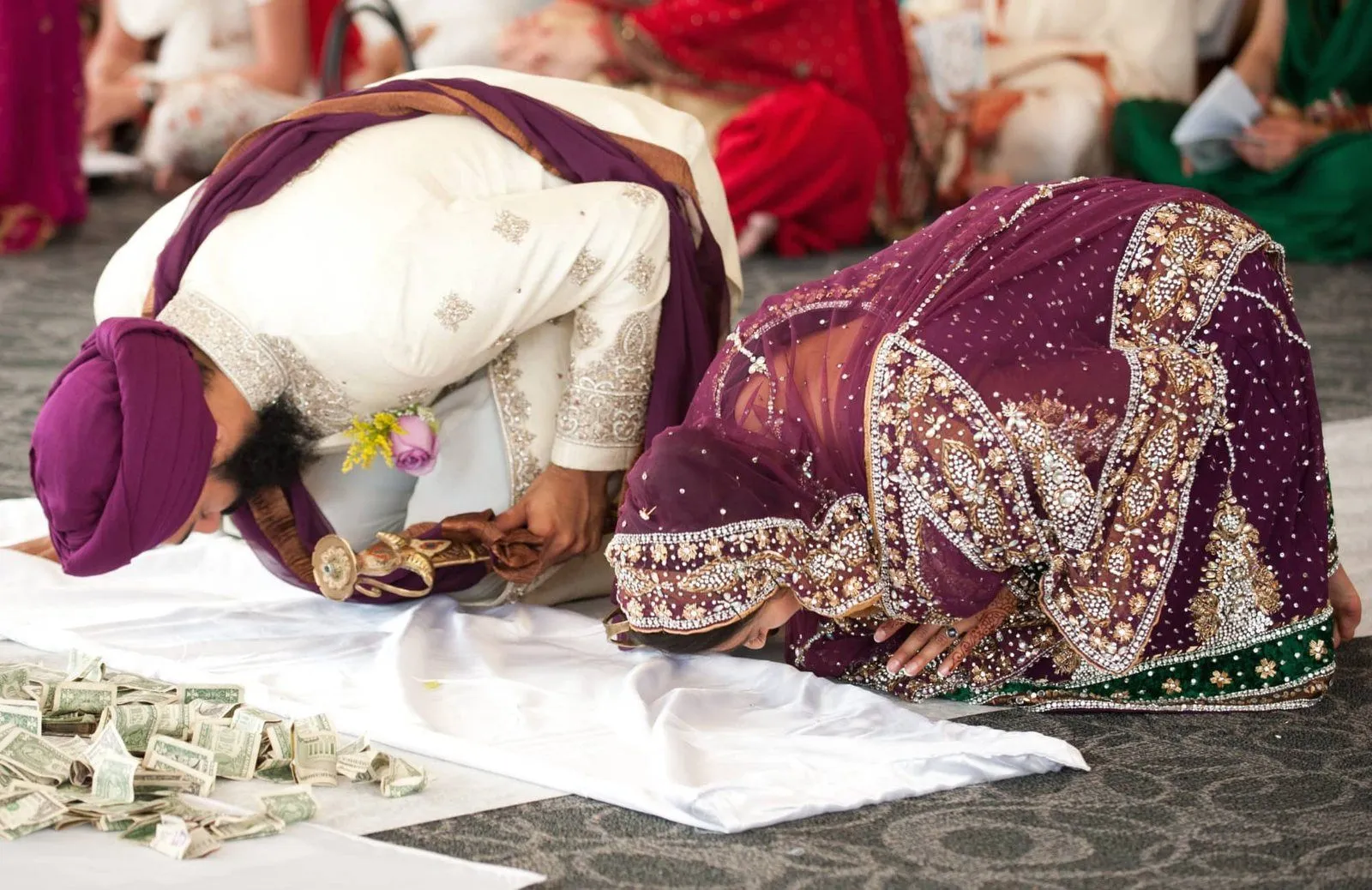
Familiarise yourself with the ceremony protocols. Know when to stand (when Guru Nanak Dev Ji’s name is heard) and when to perform Matha Tek (every time you stand up and sit down).
Walk around the Guru Granth Sahib Ji at the Gurdwara before your wedding. Getting familiar with the space you will be walking around makes the day itself feel more grounded.
The bride has a choice about when she enters. Sitting peacefully in the Darbar Sahib from the beginning, attuning herself to the kirtan before the ceremony starts, helps to focus thoughts before such a significant moment.
After the four Laavan are complete, sit together. Before talking to guests or celebrating, take the opportunity to sit with each other and absorb the commitment you have just made, to each other and to your Guru.
If you would like to learn more, YourLavaan’s supplier directory includes listings for Anand Karaj courses across the UK. You might also find our guide on why marriage education matters for single and married Sikhs a useful read.
You might also find these helpful
Destination Anand Karaj: spiritual and practical guidance before planning a wedding abroad
Are Sikhs allowed to look online for a partner?: the community debate answered honestly
It’s never too late to get married, but it can be too early: on timing, pressure, and readiness
Why marriage education matters for single and married Sikhs: building the right foundation
Still looking for your own Anand Karaj?
The Anand Karaj is about finding the right person to walk those four rounds with. Someone who shares your faith, your values, and your relationship with Sikhi. YourLavaan is the Sikh marriage platform built for exactly that, every member selfie-verified and manually approved within 24 hours.


FAQs about Anand Karaj
What does Anand Karaj mean?
Anand Karaj means “blissful union” in Punjabi. It is the Sikh wedding ceremony conducted in the presence of the Guru Granth Sahib Ji, consisting of four rounds around the holy scripture, each accompanied by a verse of Gurbani called a Laav.
How many Laavan are there in the Anand Karaj?
There are four Laavan (rounds) in the Anand Karaj. Each Laav is a verse of Gurbani composed by Guru Ram Das Ji, describing a different stage of the couple’s spiritual journey. The couple walks around the Guru Granth Sahib Ji once for each verse.
How long is an Anand Karaj?
The Anand Karaj ceremony itself takes between 30 and 45 minutes. Including the arrival, Ardas, and Karah Prasad, most ceremonies last between one and two hours in total.
Can non-Sikhs attend an Anand Karaj?
Yes. Non-Sikh guests are welcome. The requirements are the same for everyone: cover your head, remove your shoes, do not point your feet towards the Guru Granth Sahib Ji, and sit respectfully during the ceremony.
What should I wear to a Sikh wedding?
Wear modest, comfortable clothing in bright colours. Avoid skirts, shorts, tank tops, caps, and all-white or all-black outfits. Your head must be covered at all times inside the Gurdwara.
Is the Anand Karaj legally recognised in the UK?
Yes. The Anand Karaj is legally recognised in the UK under the Marriage Act 1949, provided the ceremony takes place in a registered Gurdwara.
What is the Palla in an Anand Karaj?
The Palla is a long scarf (usually pink or cream) that connects the bride and groom during the four Laavan. The bride’s father places one end into the groom’s hands before the rounds begin, symbolising the family’s trust in the groom.
Can an Anand Karaj take place outside a Gurdwara?
The Sikh Rehat Maryada states that the Anand Karaj should take place in the presence of the Guru Granth Sahib Ji with full reverence. Guidance from the Panj Pyareh should be sought before considering any alternative venue.
How do I receive Karah Prasad?
Cup both hands out together in front of you and the Karah Prasad will be placed in your palms. It is a warm, sweet offering made from flour, ghee, and sugar, given to every single person in the congregation equally.
Posted by YourLavaan. The Sikh marriage platform, built by Sikhs, for Sikhs.
Looking for a Sikh life partner? Join 600+ verified Sikh members at yourlavaan.com.

